Vol. 2 No. 1 (2026): Special Issue (September 2026)
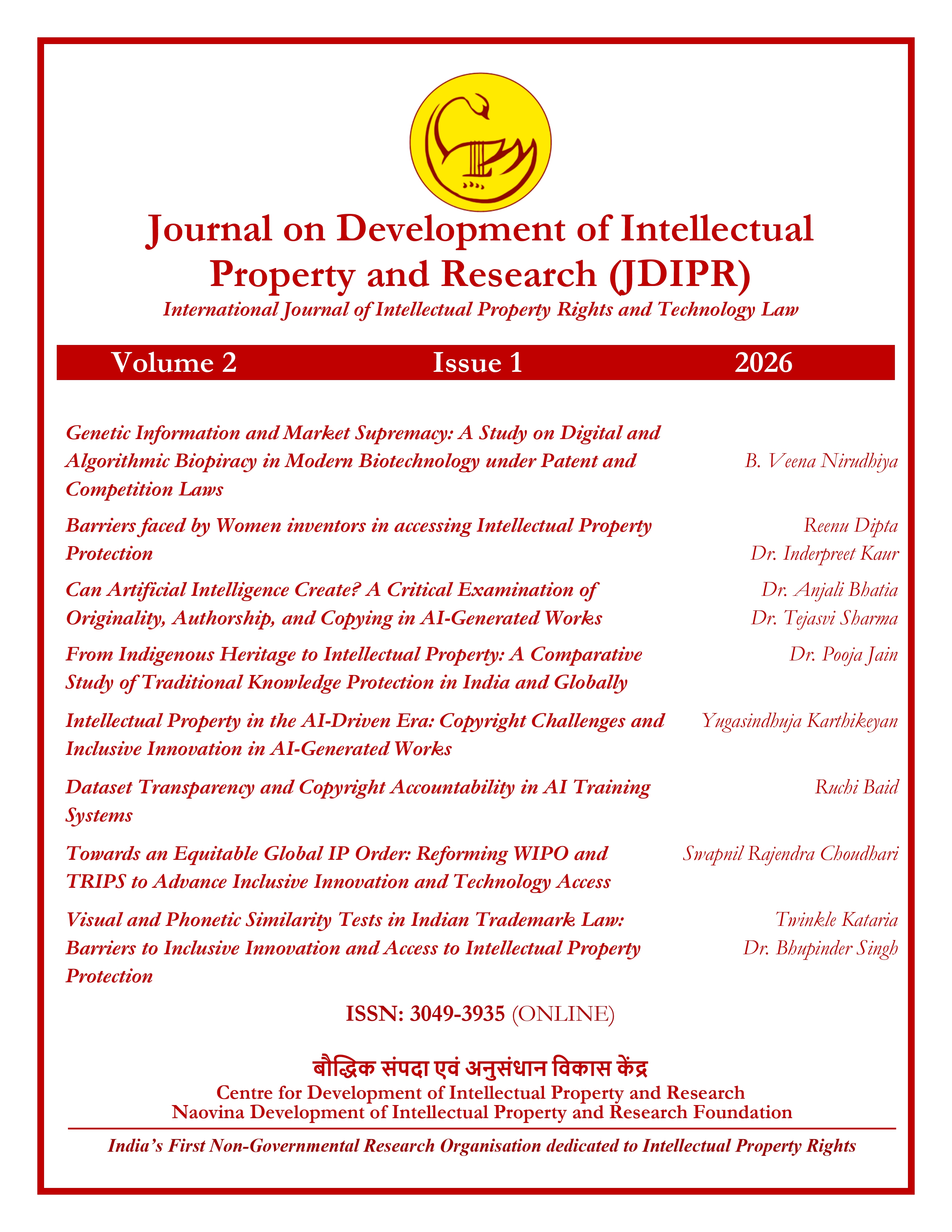
Volume: 2
Issue: 1
Year of Publication: 2026
Release Period: September 2026 (Special Issue)
Editor-in-Chief:
Prof. (Dr.) Syamala Kandadai
Professor & Dean of Faculty, National University of Study and Research in Law, Ranchi, India
Editorial Board:
Comprises distinguished scholars, legal experts, and academics from India, Bangladesh, Nepal, Pakistan, Sri Lanka, the Maldives, and the USA, representing leading universities and institutions.
Publisher:
Mr. Dipendu Das
Director, Naovina Development of Intellectual Property and Research Foundation
This first issue of Volume 2 presents eight interdisciplinary research articles examining contemporary developments in Intellectual Property Rights, artificial intelligence, biotechnology, traditional knowledge, gender and innovation, copyright, global IP governance, and trademark law. The research papers featured in this issue were presented at the International Conference on Intellectual Property Rights (ICIPR 2026), held virtually on 5–6 February 2026, Organised by the School of Law, IILM University, Greater Noida, India.
The conference was organised around the theme “Intellectual Property and Innovation for Inclusive Growth in a Transformative Era,” bringing together researchers, academicians, legal professionals, and scholars to examine contemporary developments in intellectual property law and its intersection with technological and socio-economic transformation.
The papers included in this issue represent selected scholarly contributions emerging from the conference and reflect its broader focus on intellectual property, innovation, emerging technologies, inclusivity, and access to legal protection.
Key Topics Covered:- Digital and Algorithmic Biopiracy: An examination of the appropriation of genetic and biological information through computational genomics and AI-driven biotechnology, with particular attention to patentability, access and benefit-sharing, and competition law.
- Women and Intellectual Property Protection: An analysis of the legal, institutional, socio-economic, and cultural barriers faced by women inventors, highlighting the need for gender-responsive IP policies and inclusive innovation mechanisms.
- AI, Originality and Authorship: A critical examination of whether Artificial Intelligence can create copyrightable works, addressing originality, authorship, copying, AI-generated content, and evolving approaches across jurisdictions.
- Traditional Knowledge and Indigenous Heritage: A comparative study of the protection of indigenous heritage and traditional knowledge under intellectual property frameworks in India and across the globe.
- Copyright in the AI-Driven Era: An exploration of copyright challenges arising from generative AI, including AI-generated works, creative rights, technological transformation, and the need to balance innovation with copyright protection.
- Dataset Transparency and Copyright Accountability: An examination of copyright accountability in AI training systems, focusing on transparency, evidentiary challenges, provenance, explainable/white-box AI, and technological mechanisms for ensuring responsible AI development.
- Global IP Governance and Inclusive Innovation: A critical discussion on reforming WIPO and TRIPS to advance a more equitable global intellectual property order, inclusive innovation, and wider access to technology.
- Trademark Similarity and Inclusive Innovation: An analysis of visual and phonetic similarity tests in Indian trademark law and their implications for barriers to innovation and access to intellectual property protection.
To cite this issue: (2026) 2(1) JDIPR <Page No.>
Copyright and Disclaimer© 2026 Naovina Development of Intellectual Property and Research Foundation.
All rights reserved. No part of this publication may be reproduced, distributed, or transmitted in any form or by any means, including photocopying, recording, or other electronic or mechanical methods, without the prior written permission of the Publisher and Organisation Authorities, except in the case of brief quotations embodied in critical reviews and certain other non-commercial uses permitted by copyright law.
Published:
2026-09-12


